Concrete is widely used in home repairs, sidewalks, patios, fence posts, driveways, and both small and large construction projects. For large-scale jobs, ready-mix concrete is typically delivered by a concrete truck, while pre-mixed concrete bags are a more convenient option for small projects, DIY jobs, and repair work.
One of the most common questions homeowners and contractors ask is, “How many bags of concrete are in a yard?” If you don’t calculate the correct number of bags, you may run out of concrete before finishing the job or end up buying more than you need, resulting in unnecessary costs and wasted material.
In this article, you’ll learn how many bags of concrete are in a cubic yard, how to calculate the number of bags based on different bag sizes (40 lb, 50 lb, 60 lb, and 80 lb), and practical tips to help you choose the right amount of concrete for your project.
How Many Bags of Concrete in a Yard Basic Information
Before calculating how many concrete bags are needed for 1 cubic yard, it’s important to understand the basics of cubic yards and concrete bags. This knowledge will help you estimate the correct amount of concrete more accurately.
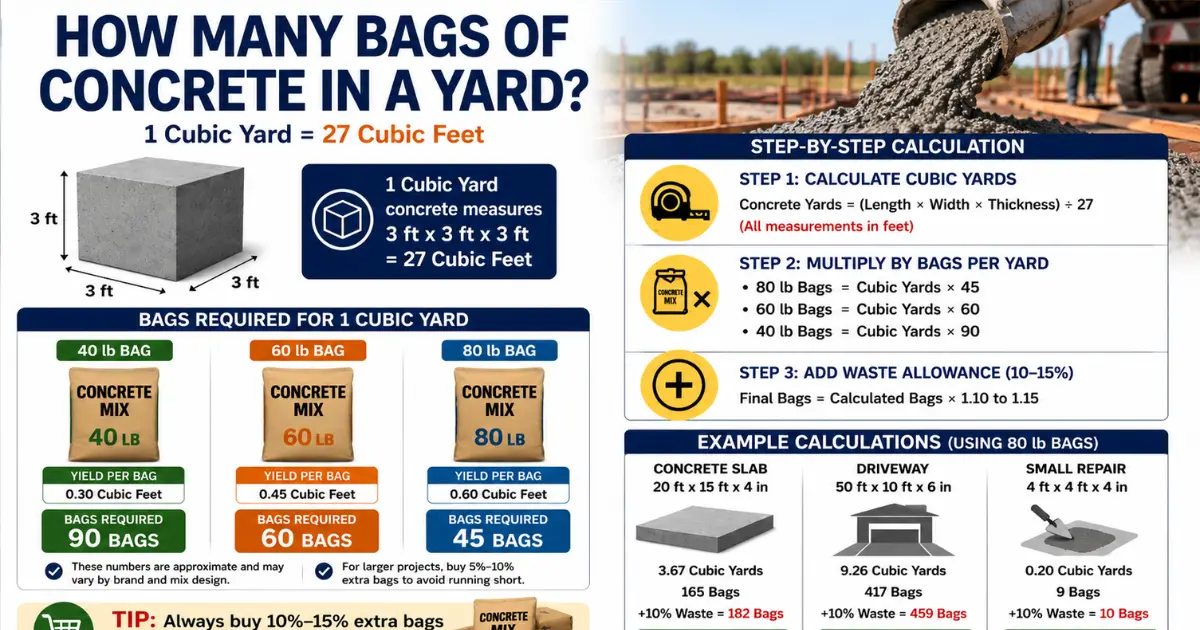
1 Cubic Yard = 27 Cubic Feet
A cubic yard is the standard unit used to measure the volume of concrete.
It measures:
- 3 feet long
- 3 feet wide
- 3 feet high
Therefore:
1 Cubic Yard = 3 × 3 × 3 = 27 Cubic Feet
This is why ready-mix concrete is sold and ordered in cubic yards.
Common Concrete Bag Sizes
Pre-mixed concrete is available in several bag sizes. The most common options include:
- 40 lb (18 kg) Bag
- 50 lb (23 kg) Bag
- 60 lb (27 kg) Bag
- 80 lb (36 kg) Bag
Since each bag produces a different amount of concrete, the number of bags required for 1 cubic yard varies depending on the bag size.
How Much Does One Cubic Yard of Concrete Weigh?
A typical cubic yard of ready-mix concrete weighs approximately 4,000 pounds (about 2 U.S. tons). However, the actual weight may vary slightly depending on the concrete mix design, aggregate type, and moisture content.
How Many Bags in One Yard?
If you plan to produce 1 cubic yard of concrete using pre-mixed concrete bags instead of ready-mix concrete, the number of bags required depends on the bag size. Larger bags produce more concrete, so fewer bags are needed.
80 lb Concrete Bags
One 80 lb concrete bag yields approximately 0.60 cubic feet of concrete.
Therefore:
27 ÷ 0.60 = Approximately 45 Bags
Answer: 1 Cubic Yard = Approximately 45 (80 lb) Concrete Bags
60 lb Concrete Bags
One 60 lb concrete bag yields approximately 0.45 cubic feet of concrete.
Therefore:
27 ÷ 0.45 = Approximately 60 Bags
Answer: 1 Cubic Yard = Approximately 60 (60 lb) Concrete Bags
40 lb Concrete Bags
One 40 lb concrete bag yields approximately 0.30 cubic feet of concrete.
Therefore:
27 ÷ 0.30 = Approximately 90 Bags
Answer: 1 Cubic Yard = Approximately 90 (40 lb) Concrete Bags
Comparison Table
| Bag Size | Approximate Yield per Bag | Bags Required for 1 Cubic Yard |
|---|---|---|
| 40 lb | 0.30 Cubic Feet | 90 Bags |
| 60 lb | 0.45 Cubic Feet | 60 Bags |
| 80 lb | 0.60 Cubic Feet | 45 Bags |
Keep in Mind
- These values are approximate and may vary slightly depending on the manufacturer and product formulation.
- For larger projects, it’s recommended to purchase 5%–10% extra bags to avoid running short during the pour.
Step-by-Step Calculation Method
If you want to determine how many concrete bags your project requires, first calculate the total cubic yards of concrete, then multiply that number by the number of bags required per cubic yard. Follow these simple steps.
Step 1: Calculate the Total Cubic Yards
Start by measuring the project’s:
- Length
- Width
- Thickness (Depth)
Then use the following formula:
Concrete Yards = (Length × Width × Thickness) ÷ 27
Note: All measurements must be in feet. If the thickness is measured in inches, divide it by 12 to convert it to feet before using the formula.
Step 2: Multiply by the Number of Bags per Yard
Once you know the total cubic yards, multiply it by the number of bags needed for your chosen bag size.
- 80 lb Bags = Concrete Yards × 45
- 60 lb Bags = Concrete Yards × 60
- 40 lb Bags = Concrete Yards × 90
This will give you the total number of concrete bags required.
Step 3: Add a Waste Allowance (10–15%)
Some concrete is typically lost due to spills, uneven surfaces, or minor measurement errors. For this reason, it’s recommended to purchase 10%–15% extra concrete bags.
Formula:
Final Bags = Calculated Bags × 1.10 (10% Waste Allowance)
or
Final Bags = Calculated Bags × 1.15 (15% Waste Allowance)
Example Calculations
Example 1: Concrete Slab
Slab Size: 20 × 15 Feet, 4 Inches Thick
- Concrete Required = 3.67 Cubic Yards
- 80 lb Bags = 3.67 × 45 = 165 Bags
- Add 10% Waste = 165 × 1.10 = 182 Bags
Answer: Approximately 182 (80 lb) Concrete Bags
Example 2: Driveway
Driveway Size: 50 × 10 Feet, 6 Inches Thick
- Concrete Required = 9.26 Cubic Yards
- 80 lb Bags = 9.26 × 45 = 417 Bags
- Add 10% Waste = 417 × 1.10 = 459 Bags
Answer: Approximately 459 (80 lb) Concrete Bags
Example 3: Small Repair
Repair Area: 4 × 4 Feet, 4 Inches Thick
- Concrete Required = 0.20 Cubic Yards
- 80 lb Bags = 0.20 × 45 = 9 Bags
- Add 10% Waste = 9 × 1.10 = 10 Bags
Answer: Approximately 10 (80 lb) Concrete Bags
Bags vs. Ready-Mix Concrete – Comparison
When purchasing concrete, one of the biggest decisions is whether to use bagged concrete or ready-mix concrete. The best choice depends on your project’s size, budget, and timeline.
When Are Concrete Bags the Better Choice?
Concrete bags are ideal for small construction projects and repair work.
Choose bagged concrete if you are:
- Building a small patio or sidewalk
- Setting fence posts or deck posts
- Repairing steps, floors, or concrete walls
- Pouring less than 1 cubic yard of concrete
- Working in an area where a ready-mix truck cannot easily access
Advantages
- Easy to purchase in small quantities
- Buy only the amount you need
- Perfect for DIY projects and minor repairs
- No minimum order requirements
When Is Ready-Mix Concrete the Better Choice?
Ready-mix concrete is the best option for medium to large construction projects.
Choose ready-mix concrete if you are:
- Pouring a house foundation
- Installing a large driveway or garage floor
- Building a concrete slab
- Working on commercial construction
- Needing 1 cubic yard or more of concrete
Advantages
- Professionally mixed to the correct proportions
- Saves significant time on large projects
- No on-site mixing required
- Consistent quality and strength
- Faster placement and finishing
Cost Comparison
| Factor | Bagged Concrete | Ready-Mix Concrete |
|---|---|---|
| Initial Cost | Lower | Higher |
| Best for Small Projects | More Cost-Effective | Less Cost-Effective |
| Best for Large Projects | Can Become Expensive | More Cost-Effective |
| Transportation | Easy to Transport Yourself | Requires Truck Delivery |
Note: For larger projects, ready-mix concrete is usually more economical on a per cubic yard basis than buying dozens of concrete bags.
Time & Labor Comparison
| Feature | Bagged Concrete | Ready-Mix Concrete |
|---|---|---|
| Mixing Time | Longer | Minimal |
| Labor Required | High | Low |
| Pouring Speed | Slower | Much Faster |
| Best for Large Projects | Not Recommended | Highly Recommended |
| DIY Projects | Excellent Choice | Limited Use |
Which Option Should You Choose?
Choose bagged concrete if:
- Your project is small.
- You’re making repairs.
- You only need a limited amount of concrete.
- You prefer a DIY approach.
Choose ready-mix concrete if:
- Your project is large.
- You need to save time and labor.
- You require 1 cubic yard or more of concrete.
- Consistent quality is important.
Tip: If your project requires about one cubic yard or more, ready-mix concrete is generally the better choice because it saves time, reduces labor, and is often more cost-effective.
Important Tips & Best Practices
Following these best practices will help you reduce waste, improve concrete quality, and complete your project more efficiently.
1. Always Buy Extra Bags (10–15%)
After calculating the required number of concrete bags, purchase an additional 10%–15% to account for spills, uneven surfaces, and minor measurement errors.
Example:
- Required = 45 Bags
- Add 10% Extra = Approximately 50 Bags
Having extra bags on hand helps prevent project delays caused by running out of concrete.
2. Mixing Ratio & Water Amount
Always follow the manufacturer’s recommended water amount printed on the concrete bag.
- Too much water can reduce the concrete’s strength.
- Too little water can make the mix difficult to work with.
- Mix only the amount of concrete that can be placed within 30–60 minutes.
Following the recommended mixing instructions ensures maximum strength and durability.
3. Storage Tips (Protect Bags from Moisture)
Proper storage is essential to maintain the quality of bagged concrete.
- Store bags in a dry, well-ventilated area.
- Keep bags off the ground using wooden pallets or a raised platform.
- Cover the bags with a plastic sheet or tarp.
- Protect them from rain, humidity, and moisture at all times.
4. Shelf Life of Concrete Bags
When stored properly, most concrete bags have a shelf life of approximately 3 to 6 months.
If a bag contains hard lumps or the cement has hardened inside, do not use it, as this can significantly reduce the strength and quality of the finished concrete.
5. Safety Precautions
Always follow proper safety practices when mixing and handling concrete.
- Wear protective gloves.
- Use safety glasses to protect your eyes.
- Wear a dust mask to avoid inhaling cement dust.
- Avoid prolonged skin contact with wet concrete, as it can cause skin irritation or chemical burns.
- Wash your hands and clean all tools thoroughly after completing the job.
Frequently Asked Questions (FAQs)
Why is it usually 45 bags of 80 lb concrete per yard?
One cubic yard contains 27 cubic feet of concrete. An 80 lb bag yields about 0.6 cubic feet of mixed concrete. So, 27 ÷ 0.6 = 45 bags.
How many 80 lb bags of concrete do I need for a 10×10 slab?
A 10 ft × 10 ft slab at 4 inches thick requires about 1.23 cubic yards. This equals roughly 55–60 bags of 80 lb concrete (including 10% extra for waste).
Can I mix multiple bag sizes together?
It is not recommended. Stick to one bag size (preferably 80 lb) for consistent strength and easier mixing.
How long do unopened concrete bags last?
Unopened bags typically last 6 to 12 months when stored in a dry place. Check for hard lumps before use — if the bag feels solid, the concrete has expired.