Calculating the weight of concrete is a very important step in any construction project. Whether you are making a foundation, pouring a driveway, constructing a patio, or installing a commercial slab, knowing the correct weight of concrete is essential for both planning and safety. If the weight estimate is wrong, then either the material may fall short or you may have to order unnecessary extra concrete, which increases both project cost and material wastage. Concrete Calculator
The use of concrete weight calculation is not only for ordering the right quantity but also for structural load calculation, transportation planning, waste management, dumpster sizing, and accurate cost estimation. For transporting heavy concrete, truck capacity must be kept in mind, while in demolition projects, knowing the weight of concrete debris allows selection of the right dumpster size. In the same way, engineers and contractors use concrete weight to calculate the load on structural members.
In this guide, we will explain in detail the basic formula for calculating concrete weight, different types of concrete and their average unit weights, step-by-step calculation method, tips for effectively using online concrete weight calculators, and practical examples of residential and commercial projects. After this, you will be able to easily calculate the approximate weight of any slab, footing, wall, column, or concrete structure.
In the USA, accurate calculation of concrete weight is considered even more important because construction projects have to follow building standards like ACI 318 and engineering requirements. Ready-mix concrete suppliers also estimate the weight of concrete along with volume for delivery planning and truck load capacity. In residential and commercial projects, knowledge of concrete weight is critical for foundation design, structural safety, equipment selection, and avoiding overloading. This is why every contractor, engineer, architect, and DIY homeowner should have a basic understanding of concrete weight calculation.
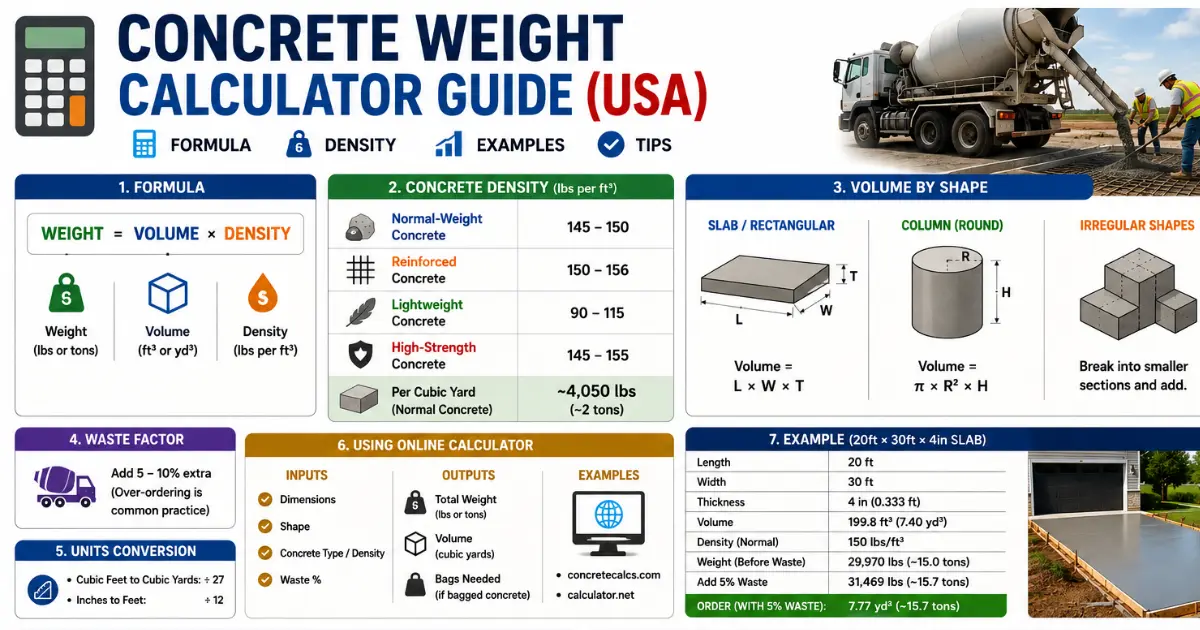
Understanding Concrete Density (Key Concept)
To calculate the weight of concrete, it is necessary to first understand concrete density. The simple meaning of density is weight per unit volume of any material. In the case of concrete, it tells how much 1 cubic foot (ft³) or 1 cubic yard (yd³) of concrete weighs. When you know the volume of concrete and its density, its total weight can be easily calculated.
Standard Concrete Density Values (USA)
In the USA, the density of concrete for engineering and construction projects varies according to its type. The most common values are given below.
| Concrete Type | Density (lbs/ft³) | Typical Use |
|---|---|---|
| Normal-Weight Concrete | 145–150 lbs/ft³ | Foundations, slabs, driveways, sidewalks, patios, walls |
| Reinforced Concrete | 150–156 lbs/ft³ | Beams, columns, bridges, structural foundations (with steel rebar) |
| Lightweight Concrete | 90–115 lbs/ft³ | Roof decks, insulation, precast panels, seismic-resistant structures |
| Heavyweight Concrete | 200–350+ lbs/ft³ | Radiation shielding, nuclear facilities, counterweights, special industrial applications |
Normal-Weight Concrete (145–150 lbs/ft³)
This is the most commonly used concrete in the USA. It uses natural stone aggregates like gravel and crushed stone. This type of concrete is most widely used for foundations, driveways, floor slabs, and sidewalks in residential and commercial projects.
Reinforced Concrete (150–156 lbs/ft³)
When steel rebar or reinforcement is added inside the concrete, the overall weight of the structure increases slightly. This is why the effective density of reinforced concrete is considered slightly higher than normal concrete. It is common in beams, columns, retaining walls, and structural foundations.
Lightweight Concrete (90–115 lbs/ft³)
In lightweight concrete, lightweight aggregates like expanded shale, clay, or pumice are used instead of normal stone aggregates. Because of its lower weight, the dead load on the building is reduced. Therefore, it is used in roof decks, insulation systems, and earthquake-prone (seismic) areas.
Heavyweight Concrete (200–350+ lbs/ft³)
Heavyweight concrete uses high-density aggregates like barite, magnetite, or hematite. This is special-purpose concrete designed for radiation shielding, nuclear power plants, hospitals, and industrial counterweights.
Concrete Weight per Cubic Yard
In the USA, concrete is generally ordered in cubic yards (yd³).
- 1 Cubic Yard = 27 Cubic Feet
- Normal-Weight Concrete (150 lbs/ft³) ≈ 4,050 lbs per cubic yard
This is approximately equal to 2 tons (US tons).
This is why ready-mix concrete suppliers calculate the total weight of concrete in advance for truck capacity and delivery planning.
Factors That Affect Concrete Weight
The exact weight of concrete is not always the same. Many factors affect its density and final weight.
1. Type of Aggregates
The aggregates used in concrete are the biggest factor. Natural stone and crushed gravel make concrete heavy, while lightweight aggregates reduce the overall density significantly.
2. Mix Design
Changing the ratio of cement, sand, aggregate, and water can also change the density of concrete. Different strength grades and special-purpose mixes can have slightly different weights.
3. Moisture Content
Fresh or wet concrete contains water, so its weight is slightly higher than dry concrete. There can be a difference in actual weight according to the moisture level.
4. Air Entrainment
In cold climates, air-entrained concrete is used to improve freeze-thaw resistance. Because of microscopic air bubbles, the density and weight of the concrete are slightly reduced.
5. Reinforcement (Steel Rebar)
Adding steel reinforcement inside the concrete increases the total weight of the structure. This is why reinforced concrete is considered slightly heavier than plain concrete, especially in structural members like beams, columns, and foundations.
Concrete Weight Calculation Formula
Calculating the weight of concrete is quite simple. First, calculate the volume of the concrete, then multiply that volume by the density of the concrete.
Basic Formula
Weight = Volume × Density
In this formula:
- Weight = Total weight of concrete (in lbs or tons)
- Volume = Total volume of concrete (in ft³ or yd³)
- Density = Weight per unit volume of concrete (approximately 150 lbs/ft³ for normal concrete)
If both volume and density are correct, the approximate weight of any concrete structure can be easily calculated.
Step 1: Calculate Concrete Volume
Before calculating weight, it is necessary to calculate the volume of the structure. Formulas are different for different concrete structures.
1. Rectangular Slab, Footing or Wall
Rectangular shapes are the most common.
Formula:
Volume = Length × Width × Thickness
Example
- Length = 20 ft
- Width = 10 ft
- Thickness = 4 inches (0.333 ft)
Volume = 20 × 10 × 0.333
Volume = 66.6 cubic feet
Now if density is 150 lbs/ft³:
Weight = 66.6 × 150
Concrete Weight ≈ 9,990 lbs
2. Circular Columns
For columns and round piers, the cylinder formula is used.
Formula:
Volume = π × (Radius)² × Height
Example
- Diameter = 2 ft
- Radius = 1 ft
- Height = 10 ft
Volume = 3.1416 × 1² × 10
Volume ≈ 31.4 cubic feet
If normal concrete is used:
Weight = 31.4 × 150
Concrete Weight ≈ 4,710 lbs
3. Irregular Shapes
If the structure is of irregular shape, the best method is to divide it into smaller rectangular or circular sections.
Steps
- Divide the structure into simple shapes.
- Calculate the volume of each section separately.
- Add all volumes together.
- Multiply the total volume by density to get the total weight.
This method is considered quite accurate for retaining walls, stepped footings, ramps, and complex foundations.
Unit Conversions
Different units are used in construction projects. Therefore, it is very important to convert measurements to the same unit before calculation.
Inches to Feet
Thickness is often given in inches.
Formula:
Feet = Inches ÷ 12
Examples
| Inches | Feet |
|---|---|
| 4 in | 0.333 ft |
| 6 in | 0.50 ft |
| 8 in | 0.667 ft |
| 12 in | 1 ft |
Cubic Feet to Cubic Yards
In the USA, ready-mix concrete is generally ordered in cubic yards.
Formula:
Cubic Yards = Cubic Feet ÷ 27
Example
81 cubic feet ÷ 27
= 3 cubic yards
This conversion makes ordering concrete from the supplier very easy.
Add a Waste Factor (Recommended)
Professional contractors generally do not order the exact quantity. A little material waste during construction is normal.
Common reasons for waste:
- Uneven ground
- Formwork leakage
- Spillage during pouring
- Finishing losses
- Measurement errors
Therefore, ordering 5% to 10% extra concrete is considered an industry standard practice.
Waste Factor Formula
Final Quantity = Calculated Quantity × (1.05 to 1.10)
Example
Calculated concrete = 5 cubic yards
5% waste:
5 × 1.05 = 5.25 cubic yards
10% waste:
5 × 1.10 = 5.50 cubic yards
This approach reduces the risk of concrete running out during the project and allows construction to be completed without interruption.
Step-by-Step Guide to Using a Concrete Weight Calculator
Today, with the help of online Concrete Weight Calculators, the weight of any concrete project can be calculated in just a few seconds. These calculators are very useful for contractors, engineers, architects, and DIY homeowners because there is no need for manual calculations and the chances of mistakes are also reduced.
Popular online calculators like ConcreteCalculatorrr.com calculate the project volume, total concrete weight, and in many cases the requirement for bagged concrete as well.
Step 1: Select the Shape
First, select the shape of your project.
Common options:
- Slab
- Footing
- Wall
- Column
- Circular Slab
- Beam
- Stair
- Custom Shape
Selecting the right shape allows the calculator to automatically use the correct volume formula.
Step 2: Enter Project Dimensions
Now enter the measurements of the structure.
Typical inputs:
- Length
- Width
- Height or Thickness
- Diameter (for circular structures)
Measurements can generally be entered in feet, inches, or meters. Most calculators in the USA support feet and inches.
Example
| Dimension | Value |
|---|---|
| Length | 20 ft |
| Width | 12 ft |
| Thickness | 4 in |
Step 3: Select Concrete Type or Density
Now choose the type of concrete.
Typical options:
- Normal-Weight Concrete (150 lbs/ft³)
- Reinforced Concrete
- Lightweight Concrete
- Heavyweight Concrete
If the calculator has an option to enter density manually, fill in the value according to the project.
Step 4: Add Waste Percentage
Professional contractors generally order 5–10% extra concrete.
If the calculator has a Waste Percentage option:
- 5% → Small residential projects
- 10% → Large commercial projects or complex shapes
This extra quantity covers pouring losses and measurement errors.
Step 5: Click Calculate
After filling all the information, click the Calculate button.
The calculator will instantly generate the result.
What Will the Calculator Show?
Most Concrete Weight Calculators provide these outputs.
1. Total Concrete Weight
The result is normally in:
- Pounds (lbs)
- Tons
Example:
Concrete Weight = 10,150 lbs (Approx. 5.08 tons)
2. Concrete Volume
The calculator also shows the volume.
Common units:
- Cubic Feet (ft³)
- Cubic Yards (yd³)
Example:
- 67.5 ft³
- 2.50 yd³
In the USA, Ready-Mix Concrete is generally ordered in cubic yards.
3. Number of Concrete Bags Required
If you are using bagged concrete instead of Ready-Mix, many calculators also estimate the required bags.
Typical bag sizes:
- 40 lb bags
- 50 lb bags
- 60 lb bags
- 80 lb bags
Example
| Bag Size | Approximate Bags Needed |
|---|---|
| 40 lb | 168 Bags |
| 60 lb | 112 Bags |
| 80 lb | 84 Bags |
This makes material purchase planning very easy.
Manual Calculation Example
If an online calculator is not available, you can also calculate concrete weight manually.
Given Data
| Parameter | Value |
|---|---|
| Length | 20 ft |
| Width | 10 ft |
| Thickness | 4 in (0.333 ft) |
| Density | 150 lbs/ft³ |
| Waste Factor | 5% |
Step 1 – Calculate Volume
Volume = Length × Width × Thickness
Volume = 20 × 10 × 0.333
Volume = 66.6 ft³
Step 2 – Calculate Weight
Weight = Volume × Density
Weight = 66.6 × 150
Weight = 9,990 lbs
Step 3 – Convert to Cubic Yards
66.6 ÷ 27
= 2.47 yd³
Step 4 – Add 5% Waste
Concrete Volume:
2.47 × 1.05
Final Volume = 2.59 yd³
Concrete Weight:
9,990 × 1.05
Final Weight ≈ 10,490 lbs (Approx. 5.25 tons)
Manual Calculation Summary
| Calculation Step | Result |
|---|---|
| Volume | 66.6 ft³ |
| Cubic Yards | 2.47 yd³ |
| Concrete Weight | 9,990 lbs |
| Weight with 5% Waste | 10,490 lbs |
| Approximate Tons | 5.25 tons |
Frequently Asked Questions (FAQs)
How much does one cubic yard of concrete weigh?
One cubic yard of normal-weight concrete weighs approximately 4,050 lbs (about 2 tons). The exact weight may vary depending on the concrete mix and aggregate type.
What is the standard density of concrete?
The standard density of normal-weight concrete is 145–150 lbs/ft³. Lightweight concrete ranges from 90–115 lbs/ft³, while heavyweight concrete can exceed 200 lbs/ft³.
How do I convert cubic feet to cubic yards?
Divide the total cubic feet by 27.
Formula:
Cubic Yards = Cubic Feet ÷ 27
What is the average weight of broken concrete?
Broken concrete used for demolition and disposal typically has an average bulk weight of approximately 75 lbs per cubic foot, which helps in selecting the correct dumpster size.