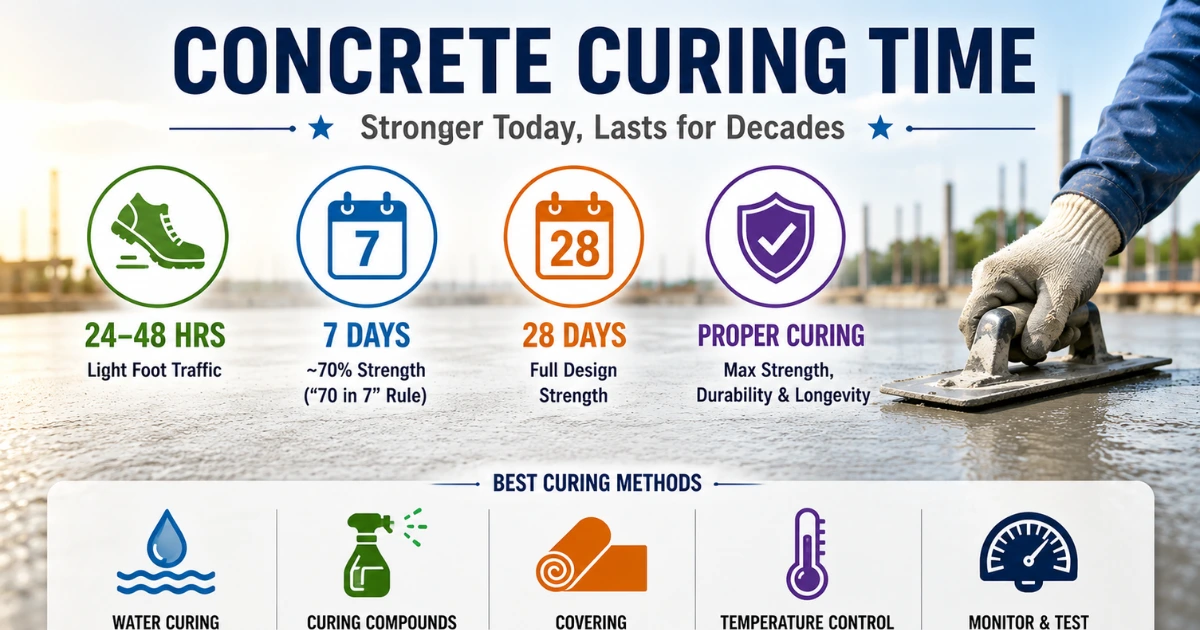
Concrete Curing is one of the most important steps in the construction process. It is the process of maintaining proper moisture, temperature, and time after concrete is placed so that the cement continues its hydration process. Proper hydration allows the concrete to develop its intended strength, durability, and crack resistance, ensuring long-term structural performance.
Without proper curing, concrete may never reach its designed strength. Inadequate curing can result in strength losses of up to 50%, along with surface cracking, shrinkage, dusting, scaling, and reduced resistance to weather, moisture, and heavy loads. These problems can shorten the service life of a structure and lead to costly repairs or premature replacement.
Because of its critical role in structural performance, concrete curing is an essential requirement for residential, commercial, and infrastructure construction. Industry standards such as ACI 318 and ACI 301 establish curing requirements to help ensure concrete achieves its specified compressive strength and long-term durability. Proper curing is especially important for foundations, slabs, driveways, sidewalks, pavements, bridges, and other structural concrete, where long-lasting performance and safety are essential.
In this guide, you’ll learn how long concrete should be cured, what factors affect curing time, different curing methods, and best practices to maximize concrete strength and durability.
Concrete Curing Time – Standard Timelines
Concrete does not reach its full strength overnight. As cement hydrates, the concrete gradually becomes stronger over time. Following the recommended curing timeline helps maximize strength, durability, and long-term performance.
1. Initial Setting (24–48 Hours)
During the first 24 to 48 hours, concrete begins to harden as the hydration process starts. While the surface may feel solid, the concrete is still gaining strength internally.
What to expect:
- Surface becomes firm enough for light foot traffic (when approved for the specific project).
- Concrete should be protected from excessive drying, rain, freezing temperatures, and heavy loads.
- Avoid driving vehicles or placing heavy equipment on the concrete during this period.
Note: Surface hardness does not mean the concrete has reached its design strength.
2. Around 70% Strength – Approximately 7 Days
Under normal curing conditions, concrete typically reaches about 70% of its specified compressive strength in approximately 7 days. This is commonly referred to as the “70 in 7” rule.
At this stage:
- Many structural elements have gained sufficient strength for formwork removal, when approved by the project engineer.
- Light structural loading may be permitted where allowed by the project specifications.
- Concrete continues to gain strength beyond this point.
Actual strength depends on the concrete mix, curing conditions, temperature, and cement type.
3. Full Design Strength – 28 Days
Concrete is generally considered to reach its design compressive strength after 28 days of proper curing. This 28-day value is the standard benchmark used for compressive strength testing.
By the end of the curing period, properly cured concrete should provide:
- Full design strength
- Maximum durability
- Better crack resistance
- Improved abrasion and weather resistance
- Long-term structural performance
Although concrete continues to gain strength beyond 28 days, the 28-day test remains the industry standard for evaluating concrete quality.
Curing Time by Cement Type
Different cement types require different minimum curing periods because they develop strength at different rates.
| Cement Type | Recommended Minimum Curing Time |
|---|---|
| Type I (Normal Portland Cement) | 7 Days |
| Type II (Moderate Sulfate Resistance) | 10–14 Days |
| Type III (High-Early-Strength Cement) | 3 Days |
High-Early-Strength Concrete
Concrete made with Type III High-Early-Strength Cement gains strength much faster than conventional concrete.
Typical applications include:
- Fast-track construction
- Highway and pavement repairs
- Cold-weather construction
- Projects requiring early opening to traffic
For these applications, a minimum curing period of 3 days is generally sufficient when the required strength has been achieved.
Strength-Based Curing Termination
Rather than stopping curing after a fixed number of days, many projects determine the end of curing based on strength development.
Curing can generally be discontinued once the concrete has achieved at least 70% of its specified compressive strength, provided this is permitted by the project specifications.
Strength can be verified using field testing methods such as:
- Concrete Cylinder Compression Tests
- Concrete Maturity Method
- Field-Cured Test Specimens
- Approved In-Place Strength Testing Methods
Strength-based curing provides a more accurate indication of concrete performance because it accounts for actual job-site conditions rather than relying solely on elapsed time.
Factors Affecting Concrete Curing Time
Concrete curing time is influenced by several factors beyond the number of days on a calendar. Temperature, weather conditions, mix design, and the size of the concrete placement all affect how quickly concrete gains strength. Understanding these factors helps ensure proper curing and long-term durability.
1. Temperature
Temperature has the greatest impact on the hydration process and curing time.
The ideal curing temperature is 50°F to 70°F (10°C to 21°C), where hydration occurs at a steady rate and concrete develops strength efficiently.
- Hot Weather: High temperatures accelerate water evaporation, causing concrete to lose moisture before hydration is complete. This can increase the risk of plastic shrinkage cracks, lower ultimate strength, and reduce durability if proper curing is not maintained.
- Cold Weather: Low temperatures slow the hydration process, delaying strength gain. If concrete freezes before reaching adequate strength, permanent damage can occur.
Different climates require different curing strategies:
- Desert Southwest: High temperatures, intense sunlight, and low humidity require continuous moisture curing to prevent rapid drying.
- Northeast Winters: Cold temperatures may require insulated blankets, heated enclosures, or other cold-weather protection to maintain proper curing conditions.
2. Humidity and Wind
Humidity and wind significantly affect how quickly moisture evaporates from fresh concrete.
- Low Humidity increases evaporation, making it more difficult to keep the concrete surface moist.
- Strong Winds remove surface moisture rapidly, increasing the likelihood of early cracking and surface defects.
- The combination of high temperatures, low humidity, and wind creates the highest evaporation rates and requires immediate curing measures.
Using curing compounds, wet coverings, or continuous water curing helps minimize moisture loss under these conditions.
3. Mix Design
The composition of the concrete mix directly influences curing time and strength development.
Important mix design factors include:
- Water-Cement Ratio: Lower water-cement ratios generally produce stronger and more durable concrete but require careful curing to prevent surface drying.
- Cement Type: Different cement types gain strength at different rates. High-early-strength cement cures faster than standard Portland cement.
- Admixtures: Accelerators, retarders, water reducers, and air-entraining admixtures can speed up or slow down hydration depending on project requirements.
- Aggregate Properties: Aggregate size, grading, and moisture content affect the concrete’s workability, heat generation, and overall curing behavior.
4. Slab Thickness and Size
The thickness and volume of a concrete placement also affect curing performance.
- Thicker slabs and structural elements retain internal heat longer, allowing hydration to continue more efficiently.
- Thin slabs lose heat and moisture more quickly, making them more susceptible to rapid drying and surface cracking.
- Large concrete placements often require longer moisture retention to ensure uniform strength throughout the structure.
Proper curing becomes increasingly important as the surface-area-to-volume ratio increases.
5. Environmental Conditions
Environmental exposure determines the type of curing method and protection required.
Hot Weather Concrete
During hot-weather placements, rapid evaporation can reduce concrete quality unless additional precautions are taken. Industry guidance such as ACI 305 recommends measures including:
- Keeping concrete cool before placement
- Beginning curing immediately after finishing
- Using curing compounds or continuous moisture curing
- Protecting concrete from direct sunlight and drying winds
Cold Weather Concrete
Cold-weather concreting requires preventing concrete from freezing while maintaining sufficient temperature for hydration. Guidance such as ACI 306 recommends:
- Using insulated curing blankets
- Heating forms or enclosures when necessary
- Maintaining recommended concrete temperatures during early curing
- Protecting fresh concrete from freezing until adequate strength is achieved
Methods of Concrete Curing
Proper curing is essential for helping concrete achieve its intended strength, durability, and long-term performance. The best curing method depends on the project type, weather conditions, and construction schedule. The following are the most commonly used curing methods in modern construction.
1. Water Curing
Water curing is one of the most effective methods because it continuously supplies the moisture needed for cement hydration. Keeping the concrete surface wet helps maximize strength development and minimizes shrinkage cracking.
Common Water Curing Methods
Ponding
A shallow layer of water is maintained on horizontal concrete surfaces for continuous curing. This method is highly effective for large slabs and flatwork where water can be retained.
Sprinkling or Fogging
Water is sprayed or misted over the concrete surface at regular intervals to prevent moisture loss. Continuous sprinkling works well during warm or dry weather.
Wet Burlap or Wet Mats
Concrete is covered with water-soaked burlap, cotton mats, or similar materials that remain moist throughout the curing period.
Advantages
- Excellent strength development
- Reduces cracking and shrinkage
- Improves surface durability
- Provides long-term performance
Limitations
- Labor-intensive
- Requires a continuous water supply
- Regular monitoring is necessary to keep the surface moist
2. Membrane Curing Compounds
Membrane curing compounds are liquid sealants sprayed onto fresh concrete to reduce moisture evaporation. Once applied, they form a protective film that helps retain water inside the concrete.
This is one of the most widely used curing methods for:
- Driveways
- Sidewalks
- Parking lots
- Concrete slabs
- Highway and pavement construction
Advantages
- Quick and easy application
- Reduces water loss effectively
- Ideal where continuous water curing is impractical
- Saves labor and water
When selecting a curing compound, choose products that comply with the appropriate ASTM standards for curing compounds to ensure reliable performance.
3. Covering Methods
Covering concrete immediately after finishing helps retain moisture and protect it from weather conditions.
Plastic Sheeting
Plastic sheets create a moisture barrier that prevents rapid evaporation. They are commonly used on slabs, foundations, and residential concrete.
Curing Blankets
Curing blankets help retain heat and moisture while protecting fresh concrete from temperature fluctuations. They are especially useful during cool weather.
Insulated Forms
Insulated forms reduce heat loss and maintain favorable curing temperatures for structural concrete placed in cold conditions.
Advantages
- Helps maintain consistent curing conditions
- Protects against rapid drying
- Reduces the risk of early-age cracking
- Improves cold-weather curing performance
4. Accelerated and Controlled Curing
Projects with tight construction schedules may use accelerated curing techniques to increase the rate of strength development while maintaining concrete quality.
Heated Enclosures
Temporary heated enclosures maintain suitable temperatures around freshly placed concrete during cold weather, allowing hydration to continue without freezing.
Maturity Monitoring
The Concrete Maturity Method estimates in-place concrete strength by measuring the relationship between time and temperature. This allows contractors to determine when concrete has achieved the required strength for formwork removal, loading, or opening to traffic.
Advantages
- Faster construction schedules
- Better quality control
- More accurate strength verification
- Reduced unnecessary curing delays
Best Practices for Selecting a Curing Method
The most appropriate curing method depends on the project’s size, environmental conditions, and performance requirements.
- Water curing provides the highest level of moisture retention and is often considered the most effective method, although it requires more labor.
- Membrane curing compounds are the preferred choice for most concrete slabs, sidewalks, driveways, and pavement projects because they are efficient and easy to apply.
- Plastic sheeting, curing blankets, and insulated forms provide excellent protection in dry, windy, or cold-weather conditions.
- Heated enclosures and maturity monitoring are ideal for projects that require accelerated construction while maintaining concrete quality.
For reliable results, select curing compounds that comply with applicable ASTM standards, and follow recognized pavement curing practices such as those recommended by the Federal Highway Administration (FHWA) for highway and pavement construction.
USA Climate Considerations & Special Cases
Climate plays a major role in concrete curing. Temperature, humidity, wind, and seasonal weather conditions all affect how quickly concrete gains strength and how well it performs over time. Adapting the curing method to local conditions helps prevent cracking, surface defects, and durability problems.
1. Hot & Dry Climates
In hot, dry regions such as Arizona, Nevada, and inland California, high temperatures, low humidity, and strong sunlight can cause moisture to evaporate rapidly from fresh concrete.
Common Challenges
- Rapid moisture loss
- Plastic shrinkage cracking
- Faster setting time
- Reduced long-term strength if curing is inadequate
Best Practices
- Begin curing immediately after finishing.
- Use continuous fogging or water misting to reduce evaporation.
- Apply approved membrane curing compounds as soon as possible.
- Cover concrete with wet burlap or plastic sheeting.
- Use sunshades or wind barriers to minimize direct exposure.
- Schedule concrete placement during cooler morning or evening hours whenever practical.
2. Cold & Freezing Conditions
Cold-weather concreting presents a different set of challenges because hydration slows significantly at low temperatures. If fresh concrete freezes before developing sufficient strength, permanent damage may occur.
Regions such as the Midwest and Northeast commonly require additional cold-weather protection during fall and winter construction.
Best Practices
- Protect concrete with insulating curing blankets.
- Use heated enclosures when temperatures remain below recommended curing levels.
- Consider accelerating admixtures or high-early-strength concrete for faster strength development.
- Maintain proper concrete temperatures throughout the early curing period.
- Prevent freezing until the concrete has developed adequate strength.
For concrete exposed to freezing conditions, it is generally recommended that the concrete achieve approximately 3,500–4,000 PSI before being subjected to repeated freeze-thaw exposure or placed into full service, depending on project requirements and specifications.
3. Humid & Coastal Areas
Humid and coastal environments reduce evaporation, but they introduce other durability concerns that should be considered during curing.
Common Challenges
- Prolonged surface moisture
- Slower surface drying
- Increased exposure to chlorides in coastal environments
- Higher risk of reinforcement corrosion if concrete quality is poor
Best Practices
- Maintain consistent curing without allowing standing water to damage the surface finish.
- Use low-permeability concrete with an appropriate water-cement ratio.
- Ensure proper drainage after curing is complete.
- Select concrete mixes designed for long-term resistance to moisture and chloride exposure.
Hot-Weather and Cold-Weather Curing Guidelines
Proper curing procedures should always match the environmental conditions during placement.
Hot-Weather Concreting
Industry guidance such as ACI 305 recommends practices that reduce rapid evaporation and maintain adequate moisture during curing, including:
- Immediate curing after finishing
- Moisture-retaining curing methods
- Wind protection
- Temperature control during placement
These practices help minimize shrinkage cracking and improve long-term durability.
Cold-Weather Concreting
Guidance such as ACI 306 focuses on maintaining suitable concrete temperatures and preventing early-age freezing by using:
- Insulating blankets
- Heated enclosures
- Temperature monitoring
- Accelerating admixtures when appropriate
Following these recommendations helps ensure proper hydration, adequate early strength development, and long-term structural performance.
Testing & Monitoring Concrete Curing
Proper testing and monitoring help verify that concrete is gaining strength as expected throughout the curing period. Instead of relying only on the number of curing days, contractors and engineers use standardized testing methods to determine when concrete is ready for formwork removal, structural loading, or opening to service.
1. Field-Cured vs. Lab-Cured Cylinders
Concrete strength is commonly evaluated using cylinder compression tests prepared according to ASTM C31.
Field-Cured Cylinders
Field-cured cylinders are stored under the same environmental conditions as the concrete placed on the job site. They provide a realistic indication of the concrete’s in-place strength.
Common Uses
- Determining when to remove formwork
- Verifying readiness for structural loading
- Opening pavements or slabs to traffic
- Evaluating actual job-site curing conditions
Lab-Cured Cylinders
Lab-cured cylinders are transported to a laboratory and cured under controlled temperature and moisture conditions. They are used to verify whether the concrete mix achieves its specified design strength.
Common Uses
- Quality control
- 28-day compressive strength testing
- Mix design verification
- Compliance with project specifications
Field-Cured vs. Lab-Cured Comparison
| Field-Cured Cylinders | Lab-Cured Cylinders |
|---|---|
| Cured under actual job-site conditions | Cured in a controlled laboratory environment |
| Reflect in-place concrete strength | Measure potential design strength |
| Used for construction decisions | Used for quality assurance and specification compliance |
2. Non-Destructive Testing (NDT)
Non-destructive testing allows engineers to estimate concrete strength without damaging the structure.
Common NDT methods include:
- Rebound Hammer Test – Estimates surface hardness and provides an indication of concrete quality.
- Ultrasonic Pulse Velocity (UPV) – Measures the speed of sound waves through concrete to evaluate uniformity and detect internal defects.
- Penetration Resistance Tests – Help estimate early-age concrete strength in certain applications.
These methods provide valuable information but are often used together with compression testing rather than as a complete replacement.
3. Concrete Maturity Meters
A Concrete Maturity Meter continuously records the concrete’s internal temperature over time and uses the maturity method to estimate strength development.
Benefits
- Real-time strength monitoring
- More accurate construction scheduling
- Reduced delays for formwork removal
- Better quality control
- Fewer unnecessary cylinder tests
Maturity monitoring is widely used for commercial buildings, bridges, highways, parking structures, and other projects where early strength verification is critical.
4. When Should Curing Stop?
Concrete curing should not end simply because a certain number of days have passed. The preferred approach is to stop curing only after the concrete has developed sufficient strength.
In most projects, curing may be discontinued when:
- The concrete has reached at least 70% of its specified compressive strength, and
- Project specifications and engineering requirements have been satisfied.
Strength can be verified using:
- Compression testing of field-cured cylinders
- Concrete maturity monitoring
- Other approved in-place strength evaluation methods
Verifying strength before ending the curing process helps ensure the concrete has developed the durability and structural performance required for long-term service.
Benefits of Proper Concrete Curing
Proper concrete curing is one of the most important factors in achieving a strong, durable, and long-lasting concrete structure. By maintaining adequate moisture and temperature during the curing period, concrete develops its full performance potential and requires less maintenance over its service life.
1. Higher Strength and Durability
Proper curing allows cement to complete the hydration process, enabling concrete to reach its intended compressive strength.
Key Benefits
- Higher compressive strength
- Improved load-bearing capacity
- Better resistance to cracking and shrinkage
- Increased abrasion resistance
- Greater durability under daily use and heavy traffic
Concrete that is cured correctly performs better under both residential and commercial service conditions.
2. Reduced Permeability
Well-cured concrete develops a denser internal structure with fewer interconnected pores, making it less permeable to water and harmful substances.
Benefits of Lower Permeability
- Reduces water penetration
- Limits chloride intrusion
- Protects reinforcing steel from corrosion
- Improves resistance to sulfate attack
- Enhances overall durability in wet environments
Lower permeability is especially important for foundations, parking structures, bridge decks, and other concrete exposed to moisture.
3. Better Freeze-Thaw Resistance
Concrete exposed to freezing temperatures must withstand repeated freeze-thaw cycles without significant deterioration.
Proper curing helps:
- Improve freeze-thaw durability
- Reduce surface scaling and spalling
- Minimize cracking caused by freezing moisture
- Extend the life of exterior concrete
When combined with air-entrained concrete, proper curing provides excellent long-term performance for driveways, sidewalks, pavements, and other exterior surfaces.
4. Longer Service Life and Lower Lifetime Costs
Concrete that is properly cured can remain strong and durable for decades with minimal maintenance.
Long-Term Advantages
- Longer structural service life
- Fewer repairs and maintenance expenses
- Lower life-cycle costs
- Better structural reliability
- Higher long-term value for residential and commercial projects
Although proper curing requires additional time and attention during construction, it significantly reduces the likelihood of premature deterioration and costly repairs in the future.
Frequently Asked Questions (FAQs)
What is concrete curing?
Concrete curing is the process of maintaining proper moisture and temperature after placement so cement can continue hydrating. Proper curing helps concrete achieve its designed strength, durability, and crack resistance.
How long should concrete be cured?
Concrete should typically be cured for at least 7 days when using normal Portland cement. It generally reaches about 70% of its design strength in 7 days and its full design strength after 28 days under proper curing conditions.
When is concrete safe to walk on?
Concrete is usually safe for light foot traffic after 24 to 48 hours, depending on weather conditions and the concrete mix. Heavy loads and vehicles should wait until the concrete has gained sufficient strength.
What is the best method for curing concrete?
The best curing method depends on the project. Water curing provides excellent strength development, while membrane curing compounds are commonly used for slabs, driveways, sidewalks, and pavement because they are efficient and easy to apply.
Does weather affect concrete curing time?
Yes. Hot, dry, and windy conditions increase moisture loss, while cold temperatures slow hydration. Proper curing methods should be adjusted to suit the weather conditions.