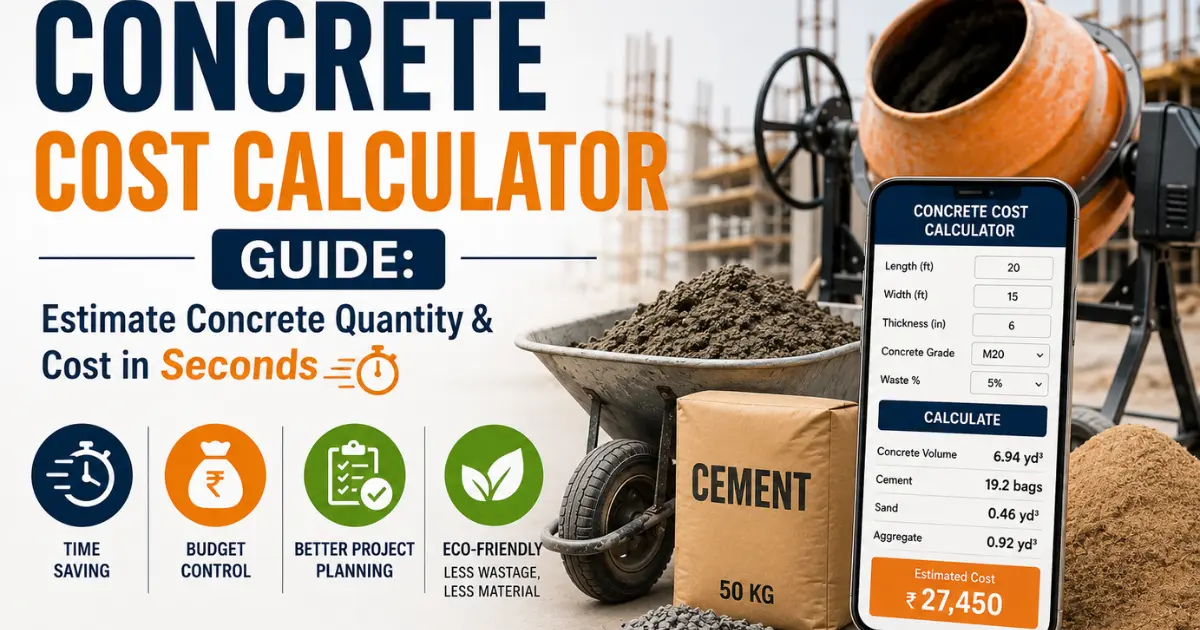
Knowing how much concrete will cost in total is extremely important before starting any construction project. Whether you are working on a driveway, slab, foundation, patio, or any other concrete project, accurate cost estimation plays a vital role in keeping your budget under control. A Concrete Cost Calculator is used to make this task easy.
The Concrete Cost Calculator is an online tool that calculates the estimated concrete quantity (volume) and total cost based on your project’s length, width, thickness, concrete price, and other necessary information. It tells you in advance how much concrete your project needs and approximately how much it will cost.
This calculator holds great importance in the construction industry because it helps with accurate budget planning, reducing unnecessary material wastage, and providing correct cost estimation. With the right estimate, you can avoid buying extra material and also prevent the problem of running short of material in the middle of the project.
If you calculate the cost manually, there is a higher chance of long calculations, unit conversions, and human errors. On the other hand, the Concrete Cost Calculator provides fast, easy, and more accurate results in just a few seconds, saving both time and effort.
In this Concrete Cost Calculator Guide, you will learn what a Concrete Cost Calculator is, how it works, the easy formula for calculating concrete cost, which factors affect concrete prices, how to use the calculator correctly, practical examples of cost calculation, and useful tips that will help reduce the cost of your construction project.
Below is the “Factors Affecting Concrete Cost” section for your “Concrete Cost Calculator Guide” article. All the points you mentioned have been included in SEO-friendly and easy language.
Factors Affecting Concrete Cost
The total cost of concrete does not depend only on the price of cement. The final cost of any construction project is affected by many different factors. If you understand all these factors, you can prepare your project budget more accurately and save yourself from unnecessary expenses.
1. Material Costs
Concrete is mainly made up of five major materials. Any increase or decrease in their prices changes the total concrete cost.
Main Materials:
- Cement – The main component that provides strength to concrete.
- Sand – Helps bind cement and aggregate together.
- Aggregate (Gravel/Stone) – Provides strength and durability to concrete.
- Water – Required for cement hydration.
- Admixtures (Chemical Additives) – Added to improve setting time, workability, water resistance, or strength.
Note: If the price of cement or aggregate increases, the total concrete cost also increases.
2. Concrete Mix Ratio
The mix ratio of concrete also affects its price. Different grades and mix designs are used for different construction projects.
Some Common Mix Ratios:
| Concrete Grade | Common Mix Ratio | Typical Use |
|---|---|---|
| M15 | 1 : 2 : 4 | Small residential work |
| M20 | 1 : 1.5 : 3 | Slabs, footings, driveways |
| M25 | Design Mix | Residential & commercial structures |
| M30 | Design Mix | Heavy-duty structures |
Higher-grade concrete uses more cement and better-quality materials, so its cost is also higher.
3. Concrete Volume Calculation
The larger the concrete volume, the higher the total cost will be.
Most Common Formula:
Volume = Length × Width × Thickness (Depth)
If measurements are in feet, first calculate cubic feet and then convert to cubic yards or cubic meters as needed.
Accurate volume calculation ensures you neither run short of concrete nor buy extra material.
4. Labor Charges
Labor is required for pouring, mixing, leveling, vibrating, finishing, and curing the concrete.
Labor cost depends on:
- Project size
- Skilled or unskilled workers
- Project completion time
- Local wage rates
In some areas, labor cost can be equal to or even higher than material cost.
5. Transportation and Delivery Charges
If you order Ready-Mix Concrete, delivery charges are also included in the total cost.
Transportation cost depends on:
- Distance from supplier to project site
- Quantity of concrete
- Type of delivery truck
- Fuel prices
- Number of trips required
Delivery charges are generally higher in remote areas.
6. Formwork, Curing, and Finishing Costs
Concrete cost is not limited to materials only. The expense of these additional tasks is also included:
Formwork
Wooden, steel, or plastic forms are used to give concrete the correct shape.
Curing
Proper curing for 7–28 days is necessary to increase concrete strength.
Finishing
Different types of finishes can be done according to the project, such as:
- Smooth Finish
- Broom Finish
- Stamped Concrete
- Exposed Aggregate Finish
- Polished Finish
Special finishes can increase the total cost.
7. Location-Based Price Variation
Concrete prices are not the same in every city, state, or region.
Concrete cost can vary according to:
- Metropolitan cities
- Small cities
- Rural areas
- Urban areas
Main reasons for price difference:
- Material availability
- Transportation distance
- Local taxes
- Labor rates
- Market competition
For example, concrete prices in big cities are usually higher than in rural areas.
8. Current Market Rates
Concrete prices keep changing with time.
Market rates are affected by:
- Changes in cement and steel prices
- Fuel cost
- Inflation
- Seasonal demand
- Government policies
- Supply chain issues
For example, during construction season, concrete prices are often higher than on normal days.
Quick Summary
| Factor | Impact on Concrete Cost |
|---|---|
| Material Costs | Cement, sand, aggregate, water, admixtures |
| Mix Ratio / Grade | Higher grades generally cost more |
| Concrete Volume | Larger volume increases total cost |
| Labour Charges | Depends on workforce and project size |
| Transportation | Delivery distance and fuel costs affect pricing |
| Formwork & Finishing | Additional services increase overall cost |
| Location | Prices vary by city, state, and rural/urban areas |
| Market Rates | Inflation, season, and material prices influence cost |
How Does a Concrete Cost Calculator Work?
The Concrete Cost Calculator is a tool that estimates the total concrete cost based on the project dimensions, concrete mix, material prices, and other expenses entered by you. It gives faster, easier, and more accurate results compared to manual calculation.
The calculator mainly works in four steps — it first calculates the concrete volume, then calculates the dry volume, determines the required material quantities, and finally adds all expenses to show the total cost.
Step 1: Calculate Concrete Volume
First, the calculator calculates the wet volume (concrete volume) of your project.
Basic Formula:
Volume = Length × Width × Height (Thickness)
If all measurements are in meters, the result will be in cubic meters (m³).
If measurements are in feet, the result will be in cubic feet (ft³).
Example:
Length = 5 m
Width = 4 m
Thickness = 0.15 m
Volume = 5 × 4 × 0.15 = 3 Cubic Meters
This is the actual (wet) quantity of concrete needed for your project.
Step 2: Apply Dry Volume Factor
When preparing concrete, some material is used in mixing, voids, and compaction. Therefore, material calculation is always done on the basis of dry volume.
Commonly used dry volume factors:
- 1.54 (most commonly used)
- 1.52 (used in some engineering calculations)
Formula:
Dry Volume = Wet Volume × 1.54
Example:
If Wet Volume = 3 m³
Dry Volume = 3 × 1.54 = 4.62 m³
This dry volume is then used to calculate material quantities.
Note: Depending on different standards or project requirements, either the 1.52 or 1.54 factor can be used.
Step 3: Calculate Material Quantity
After getting the dry volume, the calculator determines the quantities of cement, sand, and aggregate according to the selected concrete mix ratio (e.g., 1:2:4).
For example, if the mix ratio is 1 : 2 : 4, total parts = 1 + 2 + 4 = 7 Parts.
Material Calculation Formulas:
Cement
Cement = (1 ÷ Total Parts) × Dry Volume
Sand
Sand = (2 ÷ Total Parts) × Dry Volume
Aggregate
Aggregate = (4 ÷ Total Parts) × Dry Volume
After this, the calculator shows cement in bags and sand & aggregate in cubic meters or cubic feet.
If water or admixtures are included in the project, their estimated quantities can also be added.
Step 4: Calculate Total Concrete Cost
Once the quantities of all materials are known, the calculator calculates the total cost by considering the current market price of each material.
In addition, other necessary expenses are also added, such as:
- Material Cost
- Labor Charges
- Transportation & Delivery Charges
- Formwork Cost
- Finishing Cost
- Curing Cost
- Equipment Rental (if applicable)
- Other Project Expenses
Total Cost Formula:
Total Cost = Material Cost + Labor Cost + Other Expenses
This formula is the basis of almost all Concrete Cost Calculators.
What You Get in Calculator Output
After using the Concrete Cost Calculator, you generally get the following information:
- ✅ Concrete Volume (Cubic Meter / Cubic Feet)
- ✅ Dry Volume
- ✅ Cement Bags Required
- ✅ Sand Quantity
- ✅ Aggregate Quantity
- ✅ Estimated Material Cost
- ✅ Labor Cost
- ✅ Transportation Cost
- ✅ Other Construction Expenses
- ✅ Final Estimated Concrete Cost
For the most accurate results, always enter length, width, thickness, mix ratio, material prices, and labor charges correctly. If possible, also add a 5–10% contingency budget so that price changes, material waste, or unexpected expenses do not affect your project budget.
Step-by-Step Guide to Use Concrete Cost Calculator
Using the Concrete Cost Calculator is very easy. You just need to enter some required information (inputs) about your project, and the calculator tells you the concrete quantity (volume), material quantities, and total estimated cost in a few seconds.
Follow the steps below to easily estimate the cost of any concrete project.
Step 1: Enter Project Dimensions
First, enter the correct measurements of your project.
You usually need to fill in the following dimensions:
- Length
- Width
- Thickness / Depth
Step 2: Select Concrete Grade
Now choose the concrete grade according to your project.
Some common grades:
- M15 – Small residential projects
- M20 – Slabs, footpaths, driveways
- M25 – Residential buildings
- M30 – Commercial & heavy-duty structures
The quantity of cement and other materials changes according to the concrete grade, which also affects the total cost.
Step 3: Select Mix Type
Next, choose the mix type of concrete.
Nominal Mix
- For small residential projects
- Uses pre-defined mix ratios (e.g., 1:2:4, 1:1.5:3)
Design Mix
- For commercial and large projects
- Designed according to structural requirements
- More accurate and higher-strength concrete
Step 4: Select Location
Concrete prices can vary in every city and state.
Therefore, enter your:
- City
- State
- or Project Location
in the calculator so you get a more accurate cost estimate based on local material rates and labor charges.
Step 5: Enter Wastage Percentage
Some concrete waste is normal in construction work.
That is why most calculators ask for wastage percentage.
Recommended values:
- 5% – For well-planned projects
- 10% – For complex projects or when there is higher chance of waste
This extra quantity prevents your project from stopping in the middle.
How to Use Online Concrete Cost Calculator (Example)
Suppose you need to make a 15 ft × 12 ft concrete slab with 4 inches thickness.
Enter the following information in the calculator:
- Length = 15 ft
- Width = 12 ft
- Thickness = 4 in
- Concrete Grade = M20
- Mix Type = Nominal Mix
- Location = Your City/State
- Wastage = 5%
Now click the Calculate button.
In just a few seconds, the calculator will show you:
- Concrete Volume
- Dry Volume
- Cement Quantity
- Sand Quantity
- Aggregate Quantity
- Estimated Material Cost
- Labor Cost
- Total Estimated Concrete Cost
This way, you get the estimated cost of the entire project immediately without doing manual calculations.
Mobile App vs Website Calculator
Today, most Concrete Cost Calculators are available in both mobile apps and websites. Both have their own advantages.
| Feature | Mobile App | Website Calculator |
|---|---|---|
| Installation | Needs app installation | No installation required |
| Accessibility | Use anytime, anywhere | Instant access via browser |
| Updates | May need app updates | Always latest version available |
| Ease of Use | Mobile-friendly interface | More convenient on large screens |
| Best For | On-site engineers, contractors | Homeowners, builders, DIY users |
Which Option is Better?
- If you work on a construction site and need to calculate costs repeatedly, a mobile app is more convenient.
- If you are doing project planning from home, office, or laptop, a website-based Concrete Cost Calculator is a better option because entering data and viewing results is easier on a large screen.
Material Quantity Calculation Table
To make an accurate concrete cost estimate, it is necessary to know how much cement, sand, and aggregate are required to make 1 cubic meter of concrete. This quantity changes according to the concrete grade (or mix ratio).
The chart below shows the estimated material requirement for common nominal mixes and popular concrete grades.
Note: For design mix (such as M25, M30 and above), the actual material quantity may vary according to project design, structural requirements, and mix design report. The values below are approximate.
Material Quantity per Cubic Meter of Concrete
| Concrete Grade | Mix Ratio | Cement (50 kg Bags) | Sand (m³) | Aggregate (m³) |
|---|---|---|---|---|
| M10 | 1 : 3 : 6 | 4.4 Bags | 0.48 | 0.96 |
| M15 | 1 : 2 : 4 | 6.3 Bags | 0.44 | 0.88 |
| M20 | 1 : 1.5 : 3 | 8.0 Bags | 0.42 | 0.84 |
| M25* | Design Mix | 8.5–9.0 Bags | 0.40 | 0.82 |
| M30* | Design Mix | 9.5–10 Bags | 0.38 | 0.80 |
*M25 and M30 are generally Design Mix Concrete, so actual material requirement may differ according to the mix design.
- Always choose the correct concrete grade for your project.
- Update material prices according to local market rates.
- Always add 5–10% wastage in the final estimate.
- If you are using M25 or M30 Design Mix, take material quantities according to the site engineer or mix design report.
Benefits of Using Concrete Cost Calculator
In today’s time, a Concrete Cost Calculator is not just a convenience but has become an important tool for better planning of any construction project. Whether you are a homeowner, contractor, builder, civil engineer, or DIY enthusiast, this tool helps you get a fast and accurate estimate of concrete quantity and cost.
Below are the major benefits of using a Concrete Cost Calculator.
1. Time Saving
If you calculate concrete cost manually, you have to separately calculate volume, material quantity, mix ratio, and total cost. This can take a lot of time.
The Concrete Cost Calculator performs all these calculations automatically in just a few seconds.
Benefits:
- No need for manual calculation.
- Get cost estimate in a few seconds.
- Fast calculation even for large and complex projects.
- Saves time from doing repeated calculations.
2. Prevents Budget Overrun
The biggest problem in construction projects is budget overrun, which often occurs due to incorrect material estimation.
The Concrete Cost Calculator helps you prepare your budget in advance by telling you the right quantity of material and its estimated cost.
Benefits:
- Protection from buying unnecessary material.
- Reduced chance of material falling short during the project.
- Better control over the total project cost.
- Helps in reducing unexpected expenses.
3. Better Project Planning
Every successful construction project starts with good planning.
The Concrete Cost Calculator gives you this information in advance:
- How much concrete will be required.
- How many cement bags are needed.
- How much sand and aggregate will be required.
- What will be the estimated expense for buying materials.
- How much budget should be kept for labor and other expenses.
This allows you to prepare the project schedule, material procurement, and budget planning in advance, making the entire work more organized.
4. Eco-Friendly (Less Waste, Less Material)
Due to wrong estimation, often more concrete is prepared or purchased than needed, which causes material waste.
The Concrete Cost Calculator provides accurate quantity estimates, so only the required amount of material is purchased.
Environmental Benefits:
- Reduced concrete waste.
- Decreased unnecessary consumption of cement, sand, and aggregate.
- Less material disposal at the construction site.
- Better utilization of natural resources.
- Promotes sustainable and eco-friendly construction.
Quick Summary
| Benefit | How It Helps |
|---|---|
| Time Saving | Calculates concrete cost and material quantity in just a few seconds. |
| Prevents Budget Overrun | Saves from extra expenses by providing accurate cost estimates. |
| Better Project Planning | Helps in advance planning of materials, labor, and budget. |
| Eco-Friendly | Reduces both cost and environmental impact due to less material waste. |
If you are working on any concrete slab, foundation, driveway, patio, footing, or other construction project, using a Concrete Cost Calculator is a smart decision. It not only saves your time but also ensures accurate budget planning, better project management, and reduced material waste. As a result, your construction work becomes more cost-effective, organized, and environmentally friendly.
Can I use this calculator on mobile?
Yes, most Concrete Cost Calculators are mobile-friendly. You can also download a mobile app for on-site calculations.
How much does one cubic meter of concrete cost?
The cost of one cubic meter of concrete varies by location, grade, and current market rates. It usually ranges between $80 to $150+ depending on the city and concrete grade (M20, M25, etc.).
Does the calculator include labor and transportation cost?
Yes, most good Concrete Cost Calculators include labor charges, transportation/delivery charges, formwork, and finishing costs along with material costs.
How accurate is the Concrete Cost Calculator?
The calculator is quite accurate when you enter correct measurements and current local material prices. For best results, add 5–10% extra for wastage and unexpected expenses.