Accurately estimating the amount of concrete needed is essential for completing any construction project successfully, whether it’s a foundation, driveway, patio, sidewalk, slab, or road. Ordering too little concrete can delay your project, while ordering too much increases costs and leads to unnecessary material waste. concrete calculate
That’s why knowing how to calculate concrete yards is important for contractors, engineers, DIY homeowners, and anyone involved in construction. Accurate calculations help reduce costs, minimize waste, and ensure your project runs smoothly without interruptions.
In this guide, you’ll learn how to calculate concrete yards, understand the basic formula, follow a step-by-step calculation process, work through practical examples, and discover useful tips to improve accuracy.
What Is a Concrete Yard?
A concrete yard is the standard unit used to measure the volume of concrete. In construction, concrete is typically estimated and sold in cubic yards to determine the correct amount of material required for a project.
1 Cubic Yard = 27 Cubic Feet
A cubic yard measures:
3 feet × 3 feet × 3 feet
Therefore:
1 Cubic Yard = 3 × 3 × 3 = 27 Cubic Feet
This is why you divide cubic feet by 27 to convert the volume into cubic yards.
Why Is Concrete Measured in Cubic Yards?
Most ready-mix concrete suppliers sell concrete by the cubic yard. Since large construction projects such as foundations, driveways, slabs, sidewalks, and patios require significant amounts of concrete, the cubic yard has become the industry-standard unit for ordering ready-mix concrete.
Cubic Feet vs. Cubic Yards
| Cubic Feet | Cubic Yards |
|---|---|
| Used for measuring smaller volumes | Standard unit for measuring larger concrete volumes |
| Helps calculate construction volume | Used when ordering ready-mix concrete |
| 27 Cubic Feet = 1 Cubic Yard | 1 Cubic Yard = 27 Cubic Feet |
Simply put, calculate the concrete volume in cubic feet first, then divide the result by 27 to convert it into cubic yards. This is the amount you’ll use when ordering ready-mix concrete.
How to Calculate Concrete Yards Basic Formula
To calculate concrete yards, you first need the length, width, and thickness (depth) of the area being poured.
Concrete Yard Formula
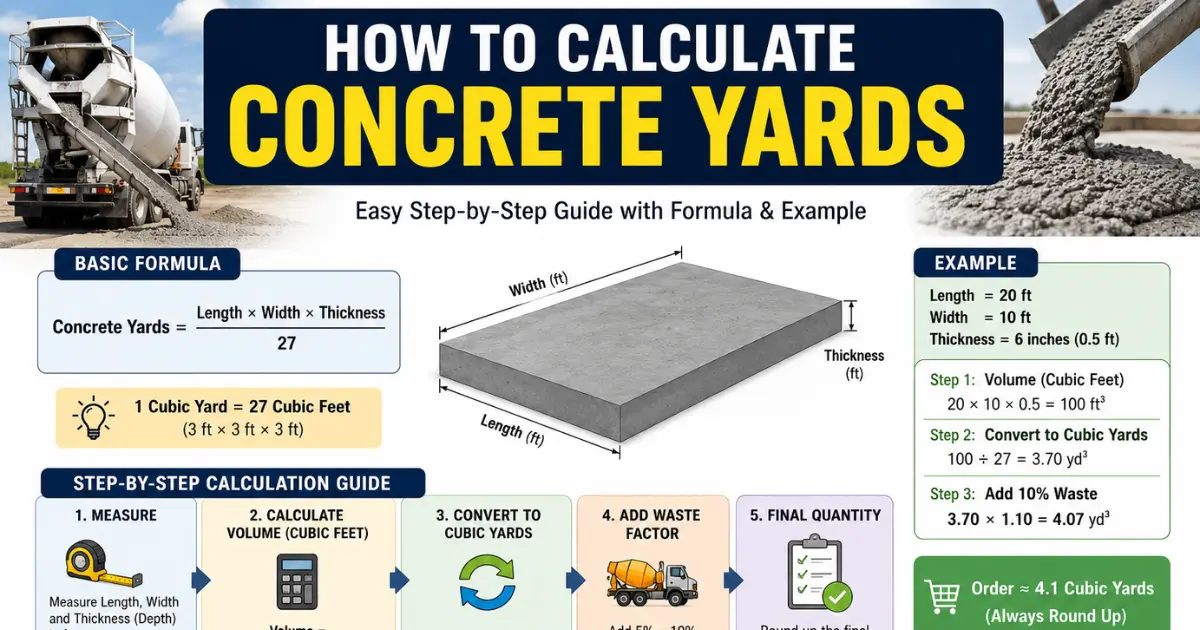
Concrete Yards = (Length × Width × Thickness) ÷ 27
All measurements should be in feet.
If the thickness is measured in inches, divide it by 12 to convert it into feet before using the formula.
Formula Explained
First, calculate the total volume in cubic feet.
Volume (Cubic Feet) = Length × Width × Thickness
Then divide the result by 27, since:
1 Cubic Yard = 27 Cubic Feet
The final result is the amount of concrete required in cubic yards.
Example
Suppose a concrete slab has the following dimensions:
- Length = 20 ft
- Width = 10 ft
- Thickness = 6 inches (0.5 ft)
Volume = 20 × 10 × 0.5 = 100 Cubic Feet
Now convert to cubic yards:
Concrete Yards = 100 ÷ 27 = 3.70 Cubic Yards
Step-by-Step Calculation Guide
Follow these simple steps to accurately estimate the amount of concrete needed for any slab, driveway, foundation, patio, or other concrete project.
Step 1: Measure the Area
Measure the following dimensions:
- Length (ft)
- Width (ft)
- Thickness/Depth (ft)
Note: If the thickness is measured in inches, divide it by 12 to convert it into feet.
Step 2: Calculate the Volume in Cubic Feet
Use the formula:
Volume (Cubic Feet) = Length × Width × Thickness
Example:
- Length = 20 ft
- Width = 10 ft
- Thickness = 0.5 ft
Volume = 20 × 10 × 0.5 = 100 Cubic Feet
Step 3: Convert to Cubic Yards
Divide the cubic feet by 27.
Concrete Yards = Cubic Feet ÷ 27
Example:
100 ÷ 27 = 3.70 Cubic Yards
Step 4: Add 5%–10% for Waste
During construction, some concrete may be lost due to spillage, uneven ground, or leftover material in the forms. For this reason, it’s recommended to order 5%–10% extra concrete.
Example:
- Calculated Amount = 3.70 Cubic Yards
Adding 10%:
3.70 × 1.10 = 4.07 Cubic Yards
Step 5: Round Up the Final Quantity
Always round your final result upward to avoid running short during the pour.
For the example above, you should order approximately 4.1 cubic yards of concrete.
Common Mistakes to Avoid
Even small mistakes when calculating concrete yards can result in higher costs, material shortages, or project delays.
1. Mixing Inches and Feet
One of the most common mistakes is using inches and feet together without converting the units.
Examples:
- 4 inches = 0.33 ft
- 6 inches = 0.50 ft
- 8 inches = 0.67 ft
Using incorrect units will produce inaccurate concrete estimates.
2. Forgetting the Waste Factor
Many people order only the exact calculated amount of concrete.
However, some concrete is usually lost because of spillage, uneven subgrades, or leftover material in forms.
Always add 5%–10% extra concrete.
3. Measuring Irregular Shapes Incorrectly
L-shaped, circular, or irregular areas should never be measured as a single rectangle.
Instead:
- Divide the area into smaller sections.
- Calculate each section separately.
- Add all the results together.
This provides a much more accurate estimate.
4. Using Old Measurements
Relying on old plans or estimated dimensions can lead to incorrect calculations.
Before ordering concrete:
- Re-measure the length, width, and thickness.
- Double-check all measurements, especially for large projects.
Useful Tips & Best Practices
1. Why Should You Order Extra Concrete?
Concrete may be lost during transportation, pouring, finishing, or because of uneven ground conditions.
Adding 5%–10% extra concrete is considered a best practice for most projects.
2. What Information Should You Provide When Ordering Ready-Mix Concrete?
When placing your order, provide:
- Required quantity (Cubic Yards)
- Concrete strength (PSI), such as 3000 PSI, 3500 PSI, or 4000 PSI
- Slab or foundation thickness
- Delivery date and time
- Project location
Providing accurate information ensures you receive the correct concrete mix for your project.
3. Hot and Cold Weather Precautions
During Hot Weather
- Concrete sets more quickly.
- Begin curing as soon as possible.
- Avoid leaving freshly poured concrete exposed to direct sunlight for long periods.
During Cold Weather
- Concrete takes longer to cure.
- Protect fresh concrete from freezing temperatures.
- Follow proper cold-weather curing practices.
4. Use Online Calculators
If you prefer not to calculate manually, online concrete calculators can estimate concrete yards within seconds.
Most calculators offer:
- Automatic cubic yard calculation
- Unit conversion
- Waste factor options
- Support for slabs, footings, driveways, patios, and foundations
- Mobile-friendly design
5. How to Estimate Concrete Cost
Use this simple formula:
Estimated Cost = Concrete Yards × Price per Cubic Yard
Example:
If your project requires 6 cubic yards and concrete costs $180 per cubic yard:
Total Cost = 6 × $180 = $1,080
Simply replace the price per cubic yard with your local concrete rate to estimate your project cost.
Tools & Calculators
Concrete yards can be calculated manually or by using digital tools. Both methods provide accurate results when the measurements are entered correctly.
Manual Method vs. Digital Calculator
| Manual Method | Digital Calculator |
|---|---|
| Requires manual calculations | Instantly calculates results |
| Takes more time | Fast and convenient |
| Higher chance of calculation errors | Reduces human error |
| Unit conversions must be done manually | Automatic unit conversion |
| Best for small projects | Suitable for projects of all sizes |
If you want faster and more accurate results, a digital concrete calculator is the better option.
Best Online Concrete Calculators
Many online concrete calculators allow you to enter the length, width, and thickness to instantly calculate the required cubic yards.
A good concrete calculator should include:
- Automatic cubic yard calculation
- Support for feet, inches, meters, and centimeters
- Waste factor option
- Calculations for slabs, driveways, foundations, patios, and footings
- Easy to use on both desktop and mobile devices
Excel Formula
You can also calculate concrete yards in Microsoft Excel or Google Sheets.
Assume:
- A2 = Length (Feet)
- B2 = Width (Feet)
- C2 = Thickness (Feet)
Formula:
=(A2*B2*C2)/27
To include a 10% waste allowance, use:
=((A2*B2*C2)/27)*1.10
This formula instantly calculates the required concrete yards while including the additional waste factor.
Frequently Asked Questions (FAQs)
What is the formula to calculate concrete yards?
The standard formula is: Cubic Yards = (Length × Width × Thickness) ÷ 27 All measurements should be in feet. Convert inches to feet by dividing by 12.
How much concrete is in 1 cubic yard?
1 cubic yard equals 27 cubic feet. At 4 inches thick, one cubic yard covers approximately 81 square feet.
How do I calculate concrete for a slab?
Measure the length, width, and thickness (in feet). Multiply them to get cubic feet, then divide by 27. Example: For a 20 ft × 15 ft slab at 4 inches (0.333 ft) thick = 3.7 cubic yards. Always add 5-10% extra for waste.
How much does one cubic yard of concrete weigh?
One cubic yard of concrete weighs approximately 3,800 to 4,000 pounds (about 1.9 to 2 tons), depending on the mix.