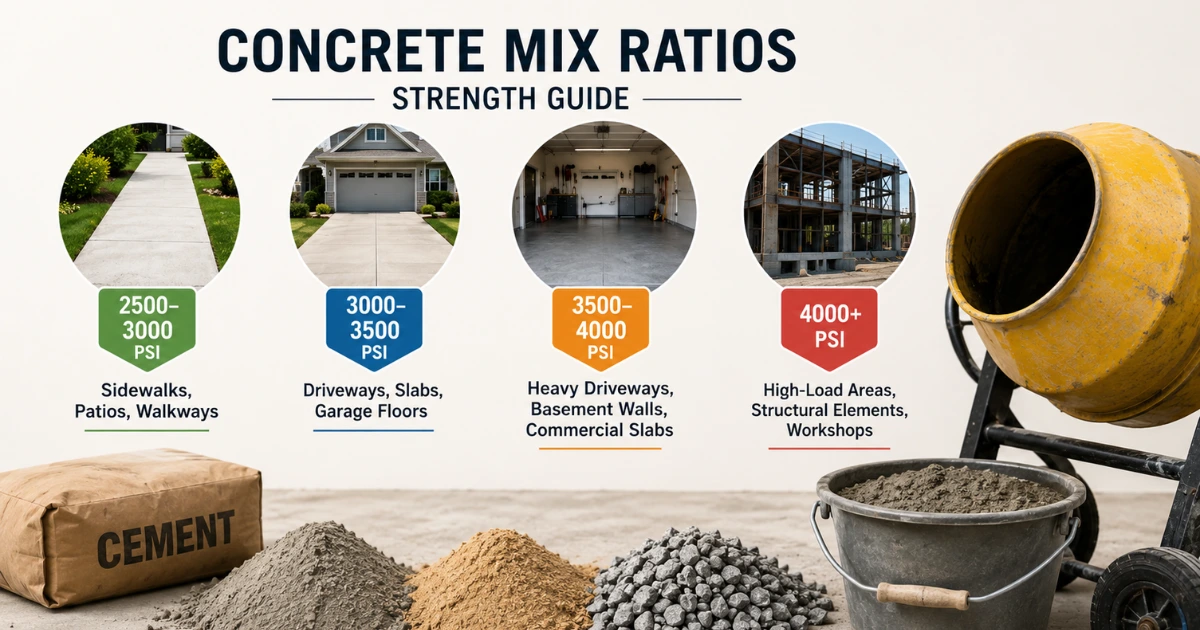
Concrete is the most widely used construction material. It is made from a precise blend of cement, sand, aggregate, and water. The right balance of these ingredients creates strong, durable, and long-lasting concrete. Concrete Mix Ratio Calculator
A concrete mix ratio refers to the proportion of cement, sand, and aggregate used. For example, a 1:2:3 mix means 1 part cement, 2 parts sand, and 3 parts aggregate. Different projects require different mix ratios depending on the required strength and load-bearing capacity.
Choosing the correct concrete mix ratio is extremely important because it directly affects the strength, durability, cost, and safety of your project. Using the wrong mix can result in weak concrete that cracks prematurely and leads to expensive repairs later. This guide explains different concrete mix ratios, their best applications, and how to choose the right one.
Main Ingredients in Concrete
The quality of concrete depends on the materials used and their proportions. Here are the key ingredients:
1. Cement (Binding Agent)
Cement is the binding agent in concrete. It holds the sand and aggregate together. When mixed with water, a chemical reaction called hydration occurs, which gradually hardens the concrete and gives it strength.
2. Fine Aggregate (Sand)
Sand fills the voids between particles, making the mix denser. It improves the finish and workability of the concrete. Always use clean, high-quality sand.
3. Coarse Aggregate (Gravel / Crushed Stone)
Coarse aggregate, also known as gravel or crushed stone, provides the main structural strength. It increases load-bearing capacity and helps reduce shrinkage. Common sizes include 3/8″, 3/4″, and 1-1/2″ stone.
4. Water
Water reacts with cement to harden the concrete. The correct amount is critical. Too much water weakens the concrete, while too little makes the mix difficult to place and finish. Maintaining the proper water-cement ratio is essential.
5. Optional: Admixtures (Performance-Enhancing Chemicals)
Admixtures are chemical additives used to improve specific properties such as workability, setting time, strength, water resistance, and durability. Common types include superplasticizers, accelerators, retarders, and waterproofing admixtures.
How Concrete Mix Ratios Are Written
Concrete mix ratios are expressed in parts. They show the proportion of cement : sand : gravel.
Example: What Does 1:2:3 Mean?
- 1 Part Cement
- 2 Parts Sand
- 3 Parts Gravel
If you use one bucket of cement, you add two buckets of sand and three buckets of gravel. Water is added separately based on the required water-cement ratio.
Volume Basis vs. Weight Basis
- Volume Basis: Materials are measured with buckets or containers. This is common for small residential and DIY projects because it is simple and fast.
- Weight Basis: Materials are weighed in pounds or tons. This method is used for larger commercial and engineered projects for better accuracy and consistency.
Importance of Water-Cement Ratio
The water-cement ratio significantly affects concrete strength and durability. Too much water reduces strength and increases cracking risk. Too little water makes the mix hard to work with. Always follow the proper ratio for your project.
Types of Concrete Mix
Concrete mixes are classified based on required strength, performance, and application. Choosing the right mix ensures long-lasting durability, structural integrity, and cost-effective construction.
1. Standard Mix
A Standard Mix is the most common choice for residential and light commercial construction. It is produced to meet a specific compressive strength measured in PSI (Pounds per Square Inch).
Common Applications
| Concrete Strength | Best For |
|---|---|
| 2,500 PSI | Sidewalks and Walkways |
| 3,000 PSI | Patios and Driveways |
| 3,500 PSI | Residential Slabs |
| 4,000 PSI | Foundations, Footings, Garage Floors |
| 5,000+ PSI | Heavy-Duty Structural Projects |
Key Features
- Consistent quality
- Ready-to-use from concrete suppliers
- Suitable for most residential projects
- Reliable strength and durability
2. Design Mix
A Design Mix is engineered to meet specific structural and environmental requirements through laboratory testing.
Common Applications
- High-rise buildings
- Bridges
- Parking structures
- Industrial floors
- Retaining walls
- Heavy-load foundations
Key Features
- Custom-engineered mix
- High compressive strength
- Excellent durability
- Optimized for demanding conditions
3. Specialty Concrete Mix
Specialty mixes provide enhanced performance beyond standard concrete.
Examples
- High-Strength Concrete
- Air-Entrained Concrete
- Fiber-Reinforced Concrete
- Fast-Setting Concrete
- Self-Consolidating Concrete (SCC)
- Waterproof Concrete
These are used where improved durability, freeze-thaw resistance, crack control, or faster construction is needed.
Common Concrete Mix Ratios and Their Uses
| Concrete Strength (PSI) | Typical Mix Ratio (Cement : Sand : Gravel) | Common Uses |
|---|---|---|
| 2,500–3,000 PSI | 1 : 3 : 3 or 1 : 2.5 : 3 | Sidewalks, patios, walkways, light-duty footings |
| 3,000–3,500 PSI | 1 : 2 : 3 | Residential foundations, slabs, driveways, garage floors |
| 3,500–4,000 PSI | 1 : 2 : 2.5 or richer 1 : 2 : 3 | Heavy-duty driveways, basement walls, commercial slabs |
| 4,000+ PSI | Rich mix (higher cement content) | Structural elements, industrial floors, retaining walls |
1:2:3 Mix – The Most Common Residential Mix
The 1:2:3 mix offers an excellent balance of strength, durability, workability, and cost. It is widely used for foundations, footings, garage floors, residential driveways, concrete slabs, and small retaining walls.
Air-Entrained Concrete for Cold Climates
In areas with frequent freeze-thaw cycles, air-entrained concrete is recommended. It contains microscopic air bubbles that provide space for water to expand when freezing.
Benefits:
- Improved freeze-thaw durability
- Reduced surface scaling
- Better crack resistance
- Longer service life
Common Uses: Driveways, sidewalks, exterior slabs, steps, and parking areas.
Follow Local Building Codes
Always verify required compressive strength (PSI) and comply with local building codes and ACI standards for structural work.
Concrete Strength Ratings (PSI)
Concrete strength is measured in PSI based on its 28-day compressive strength.
Minimum PSI Recommendations
| Application | Recommended Minimum Strength |
|---|---|
| Sidewalks & Walkways | 2,500–3,000 PSI |
| Patios | 3,000 PSI |
| Residential Driveways | 3,000–3,500 PSI |
| Garage Floors | 4,000 PSI |
| Concrete Slabs | 3,500–4,000 PSI |
| Footings & Foundations | 4,000 PSI |
| Basement Walls | 4,000 PSI |
| Structural & Heavy-Load | 4,000–5,000+ PSI |
3,000 PSI vs 4,000 PSI
- Choose 3,000 PSI for patios, sidewalks, and light-duty applications (more economical).
- Choose 4,000 PSI for foundations, garage floors, heavy driveways, and structural work (better durability and load capacity).
Factors That Affect Concrete Mix Ratio
Key factors include required strength (PSI), workability, weather conditions, soil type, structural loads, and exposure conditions (moisture, chemicals, de-icing salts, etc.).
Concrete Mixing Methods
1. Hand Mixing
Best for small DIY repairs, fence posts, stepping stones, and minor patches.
2. Portable Concrete Mixer
Ideal for medium residential projects like slabs, sidewalks, patios, and small foundations.
3. Ready-Mix Truck
The most common and preferred method for foundations, driveways, garage floors, and large pours.
4. Pumped Concrete
Used for hard-to-reach areas, multi-story buildings, and elevated slabs.
Advantages of Using the Correct Concrete Mix Ratio
- Better strength and durability
- Compliance with building codes
- Cost efficiency and reduced maintenance
- Long service life (50 years or more under normal conditions)