For any construction project such as a house foundation, driveway, patio, sidewalk, or concrete slab, estimating the correct amount of concrete is extremely important. If you order too little concrete, the work may stop midway. On the other hand, ordering too much concrete can lead to unnecessary expenses. Concrete Calculators
This is why concrete quantity calculation is considered an essential part of every construction project. In the concrete industry, volume is commonly measured in cubic yards because it is the standard and most convenient unit for large construction jobs.
In this article, you will learn what a cubic yard is, how to calculate concrete volume, and how to determine the amount of concrete needed for slabs, driveways, foundations, and other projects.
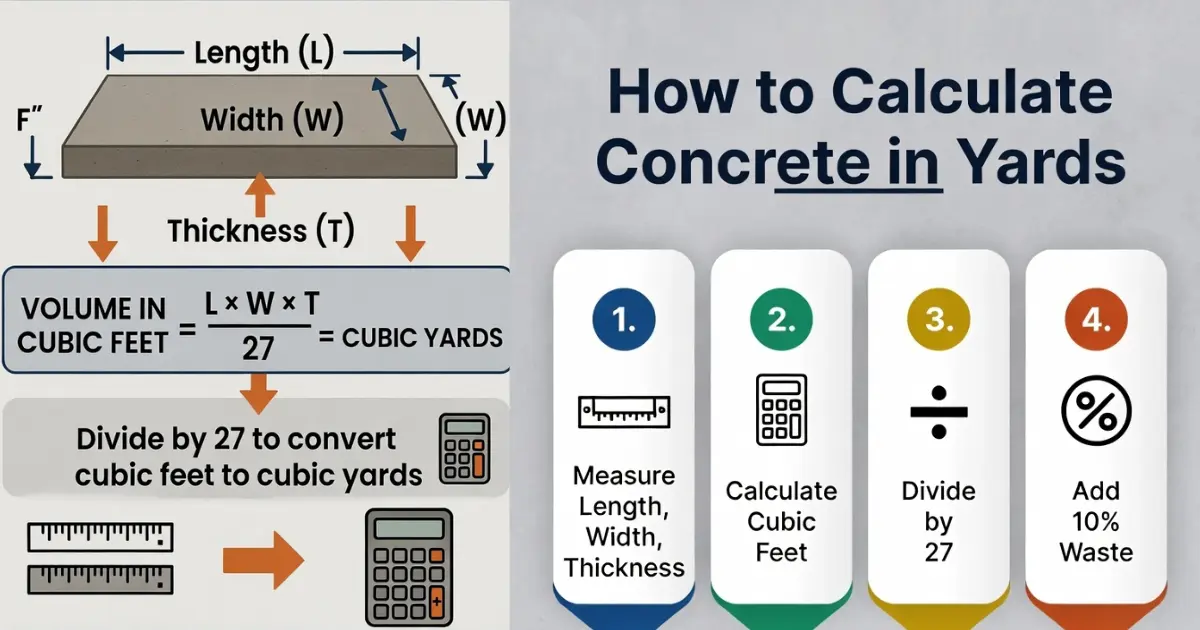
How to Calculate Yards of Concrete
To calculate concrete yards, you need the length, width, and depth of the area where concrete will be poured. Follow the steps below for an accurate calculation.
Step 1: Measure the Area Correctly
First, measure the dimensions of the area in feet.
- Length = Length (ft)
- Width = Width (ft)
- Depth = Thickness/Depth (ft)
If the thickness is measured in inches, divide it by 12 to convert it into feet.
Step 2: Calculate Volume in Cubic Feet
Use the following formula:
Volume (Cubic Feet) = Length × Width × Depth
Example:
- Length = 20 ft
- Width = 10 ft
- Depth = 0.5 ft (6 inches)
Volume = 20 × 10 × 0.5 = 100 Cubic Feet
Step 3: Convert Cubic Feet to Cubic Yards
Since:
1 Cubic Yard = 27 Cubic Feet
Use this formula:
Cubic Yards = Cubic Feet ÷ 27
Example:
100 ÷ 27 = 3.70 Cubic Yards
Step 4: Add a Waste Factor (5%–10%)
Some concrete is usually lost due to spillage, uneven surfaces, or other construction factors. Therefore, adding an extra 5%–10% is recommended.
Example:
3.70 × 1.10 = 4.07 Cubic Yards
Step 5: Determine the Final Quantity
Round up the final result to ensure you do not run short during the project.
In the example above, you should order approximately 4.1 Cubic Yards of concrete.
Basic Formula
The most commonly used formula for calculating concrete yards is:
Cubic Yards = (Length × Width × Thickness) ÷ 27
Where:
- Length = Length (in feet)
- Width = Width (in feet)
- Thickness = Depth/Thickness (in feet)
Why Is 1 Cubic Yard Equal to 27 Cubic Feet?
A cubic yard measures:
- 3 feet long
- 3 feet wide
- 3 feet high
Therefore:
3 × 3 × 3 = 27 Cubic Feet
This is why cubic feet are divided by 27 to convert them into cubic yards.
Understanding the Formula in Simple Terms
First, multiply the length, width, and thickness to find the total volume in cubic feet. Then divide the result by 27 to get the volume in cubic yards.
Example:
- Length = 20 ft
- Width = 10 ft
- Thickness = 0.5 ft
Cubic Yards = (20 × 10 × 0.5) ÷ 27
= 100 ÷ 27
= 3.70 Cubic Yards
This means approximately 3.7 cubic yards of concrete are required for the slab.
Unit Conversion Tips
To calculate concrete accurately, all measurements should be converted into the same unit, preferably feet.
How to Convert Inches to Feet
If thickness is given in inches, divide it by 12.
Feet = Inches ÷ 12
Examples:
- 4 inches = 4 ÷ 12 = 0.33 feet
- 6 inches = 6 ÷ 12 = 0.50 feet
- 8 inches = 8 ÷ 12 = 0.67 feet
Converting Centimeters and Meters to Feet
- 1 Meter = 3.281 Feet
- 1 Centimeter = 0.0328 Feet
Examples:
- 2 meters = 2 × 3.281 = 6.56 feet
- 30 cm = 30 × 0.0328 = 0.98 feet
Calculating Circular Areas
For a circular area, first calculate the area:
Area = 3.14 × Radius × Radius
Then:
Volume = Area × Thickness
Finally, divide the volume by 27 to get cubic yards.
Calculating L-Shaped Areas
For an L-shaped area:
- Divide it into two rectangles.
- Calculate the area of each section separately.
- Add both areas together.
- Multiply the total area by the thickness.
- Divide the volume by 27 to get cubic yards.
Calculating Irregular Shapes
Break irregular areas into smaller rectangles, squares, or circular sections. Calculate each area separately, add them together, and then multiply by the thickness to find the total volume. Divide by 27 to obtain cubic yards.
Tip: For complex or irregular designs, add an extra 5%–10% concrete to avoid shortages.
Recommended Thickness for Different Projects
Different construction projects require different concrete thicknesses. The table below shows commonly recommended thicknesses.
| Project | Recommended Thickness |
|---|---|
| House Slab / Flooring | 4–6 Inches |
| Driveway | 4–6 Inches |
| Garage Floor | 5–6 Inches |
| Sidewalk | 4 Inches |
| Foundation / Footing | 8–12 Inches (or as designed by an engineer) |
| Patio / Porch | 4 Inches |
Important Considerations
- If heavy vehicles will use the driveway, a thickness of 6 inches or more is recommended.
- Garage floors may require additional thickness for trucks or heavy equipment.
- Foundation and footing thickness depend on soil conditions, building loads, and local building codes.
- A 4-inch thickness is generally sufficient for patios, porches, and sidewalks.
Always check local building codes and engineering requirements for the best results.
Common Mistakes to Avoid
Even small calculation errors can result in extra costs or material shortages. Avoid the following common mistakes.
1. Mixing Units (Inches vs Feet)
One of the most common mistakes is mixing inches and feet in calculations. Always convert inches into feet before calculating.
Examples:
- 6 Inches = 0.5 Feet
- 4 Inches = 0.33 Feet
Using incorrect units can significantly affect the final result.
2. Not Adding a Waste Factor
Many people order concrete based only on the calculated quantity. However, some material is usually lost during construction.
For this reason, it is recommended to add 5%–10% extra concrete.
3. Incorrectly Measuring Irregular Shapes
Treating L-shaped, circular, or irregular areas as a single shape often produces inaccurate results.
A better approach is to:
- Divide the area into smaller sections.
- Calculate each section separately.
- Add the results together.
4. Relying on Old Measurements
Old drawings, estimated dimensions, or previous measurements may not always be accurate. Site conditions can change over time.
Before ordering concrete:
- Re-measure the length, width, and thickness.
- Double-check measurements for important projects.
Accurate measurements and proper unit conversions are the keys to determining the correct amount of concrete, saving both time and money.
Modern Tools & Calculators
Online Concrete Calculators
Today, manual calculations are no longer necessary for estimating concrete volume. Various online concrete calculators can provide accurate concrete yard estimates within seconds.
Typically, you only need to enter:
- Length
- Width
- Thickness/Depth
- Measurement Unit (Feet, Inches, Meters, etc.)
The calculator will automatically determine the total volume in both cubic feet and cubic yards. Many modern calculators also include a waste factor option to help prevent shortages.
Benefits of Online Concrete Calculators
- Fast and easy calculations
- Reduced human errors
- Automatic unit conversions
- Waste factor adjustments
- Suitable for slabs, driveways, patios, footings, foundations, and more
If you want quick and accurate results, using an online concrete calculator is the most convenient solution.
How much concrete is in one cubic yard?
One cubic yard of concrete equals 27 cubic feet of concrete.
How much concrete is needed for a 4-inch slab?
To determine how much concrete is needed for a 4-inch slab, you need the slab’s length and width.
How much waste allowance should be kept?
When ordering concrete, it is recommended to add a waste allowance of 5% to 10% to your calculated quantity.